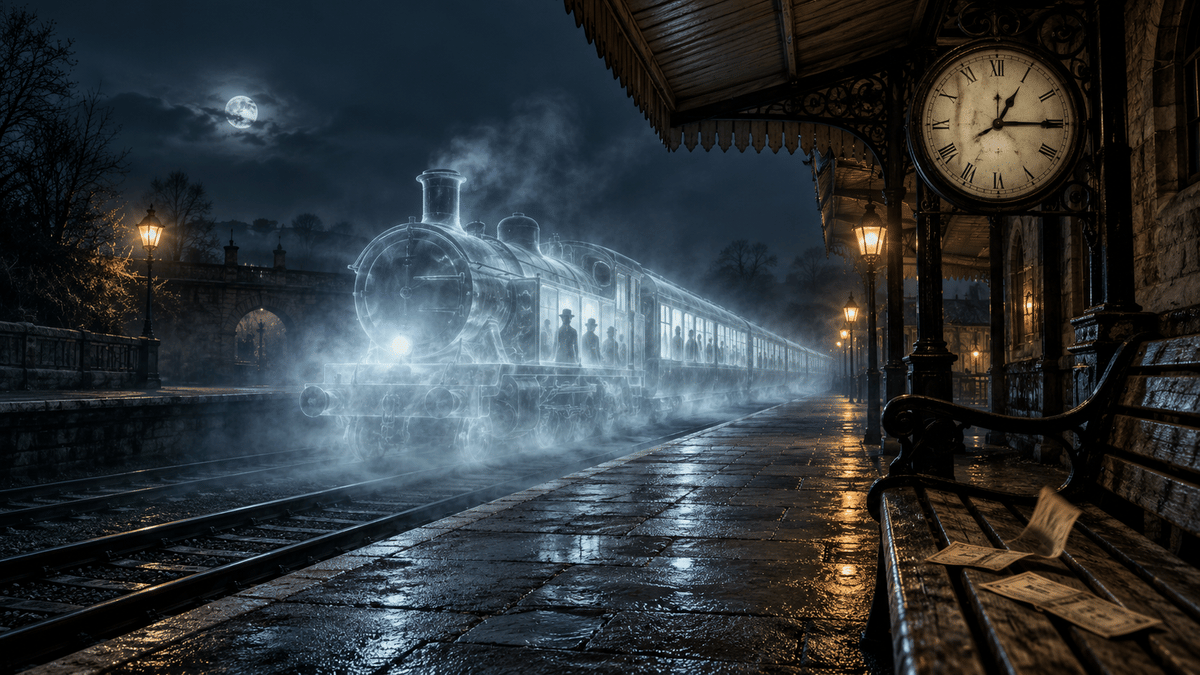
There is something peculiarly unsettling about waiting for public transport after dark.
The station is almost deserted. The platform lights cast long shadows. Somewhere in the distance, you hear the unmistakable sound of an approaching train. You check the departure board but no service is due.
Then the train appears.
It passes through the station without stopping, carrying passengers who stare silently from its windows. Moments later, everything is quiet again.
Perhaps it was an empty service. Perhaps you misread the timetable. Or perhaps you have just witnessed a journey that has been repeating itself for decades.
Stories of haunted transport can be found around the world, but some of the strangest involve phantom vehicles that apparently follow a timetable. They return at the same hour, travel along the same route or appear on the anniversary of a death or disaster.
Most living passengers would struggle to achieve such punctuality.
The Phantom Number 7
At approximately 1:15 in the morning, motorists travelling through North Kensington were said to encounter a red London double-decker bus.
There was nothing particularly unusual about a London bus, except that this one reportedly had no driver, carried no passengers and was travelling along a road where no Number 7 service was scheduled to be at that hour.
Stories of the phantom bus became associated with Cambridge Gardens and the junction with St Mark’s Road in Ladbroke Grove during the 1930s. Witnesses allegedly described an illuminated double-decker suddenly bearing down upon them before disappearing without explanation.
The legend became considerably darker after a motorist was reportedly killed in 1934. According to the story, the driver swerved to avoid the mysterious bus and crashed into a wall. When the scene was examined, no second vehicle could be found.
Accounts differ about exactly when the phantom bus first appeared and how many people encountered it. Nevertheless, one detail remains remarkably consistent throughout the legend: the time.
The bus arrived at approximately 1:15 a.m.
It was an oddly precise appointment for a vehicle that did not officially exist.
Was it an ordinary bus glimpsed in poor visibility? Could tired drivers have mistaken reflected lights for an approaching vehicle? Or did the repeated telling of the story eventually cause every sighting to acquire the same memorable time?
Whatever the explanation, the phantom Number 7 apparently continued to make occasional appearances for decades—without a conductor, a destination or any apparent concern for the Highway Code.
Abraham Lincoln’s Final Journey
Following the assassination of President Abraham Lincoln in April 1865, his body was transported from Washington to Springfield, Illinois, aboard a specially prepared funeral train.
The journey lasted almost two weeks and retraced much of the route Lincoln had travelled when he first went to Washington as president-elect. The train passed through numerous cities, allowing vast crowds to gather along the tracks and pay their respects. It became one of the most extraordinary public displays of mourning in American history.
Such a powerful communal experience was perhaps destined to produce its own ghost story.
According to later folklore, Lincoln’s funeral train continues to travel along parts of its original route during the anniversary period of his death. Witnesses are said to have seen a spectral locomotive draped in black, sometimes accompanied by funeral music, tolling bells or the shadowy figures of mourners.
Some versions of the legend claim that every clock and watch in the surrounding area stops as the phantom train passes. Afterwards, the timepieces are supposedly found to be several minutes slow, as though the train has carried a small portion of time away with it.
There is firm historical evidence for the real funeral train and its extraordinary journey. The spectral version belongs to folklore, emerging from the powerful impression the procession left upon those who witnessed it.
Perhaps this is how some phantom journeys begin. An event is seen by thousands of people, remembered for generations and eventually becomes something that can be witnessed again.
The Boleyn Coaches
Ghosts were apparently following timetables long before the arrival of the railways.
Across Britain, phantom coaches are frequently said to appear on particular nights or anniversaries. Some of the most elaborate examples are connected with Anne Boleyn and her family.
Anne was executed at the Tower of London on 19 May 1536. According to one enduring legend, her ghost returns to Blickling Hall in Norfolk, the house traditionally regarded as her birthplace, on the anniversary of her execution.
She is said to arrive in a spectral coach drawn by four headless horses and driven by a headless coachman. Inside sits the ghost of Anne herself, dressed in white and carrying her severed head upon her lap.
When the coach reaches the entrance to Blickling Hall, it disappears. Anne’s spirit is then said to wander through the house until daybreak.
It is a particularly gruesome version of the anniversary apparition. Anne does not simply return to the place associated with her birth; she is forced to repeat the journey while carrying a permanent reminder of her execution.
Another Norfolk tradition concerns Anne’s father, Sir Thomas Boleyn. He is supposedly condemned to drive a phantom coach across a series of bridges every year on the anniversary of his daughter’s death.
Some versions say he must cross eleven bridges before morning; others increase the number to forty. In certain retellings, Sir Thomas is himself headless, while in others the headless figure is his coachman.
It is possible that the two legends have become entangled over time: Anne arriving at Blickling Hall with her head upon her lap, and her father undertaking an endless journey across the bridges of Norfolk.
What remains consistent is the date.
Every 19 May, the Boleyn family’s phantom coaches are supposedly compelled to travel again.
It is almost a supernatural form of punishment: not merely to haunt one location, but to repeat the same journey year after year, keeping an appointment that can never be cancelled.
The Grey Train of Dunphail
Scotland has its own mysterious railway traveller.
Dunphail once had a station on the railway line between Forres and Aviemore in Moray. During the twentieth century, stories began to circulate about a strange grey train seen travelling through the area.
Accounts place reported sightings during the 1920s and again in the 1960s. One version of the legend connects the apparition with an earlier incident in which a train carrying cattle caught fire near Dava Station, killing the animals trapped aboard.
Unlike Lincoln’s funeral train or the Boleyn coaches, the Grey Train does not appear to have one firmly established anniversary on which it returns. Nevertheless, it shares one of the most intriguing features of phantom transport stories: it continues to use a route long after the world around it has changed.
Railway lines close. Stations are demolished. Timetables are withdrawn and the tracks themselves may eventually disappear beneath roads, fields and new buildings.
Yet, according to the folklore, the trains continue to run.
Witnesses sometimes report hearing whistles, wheels or engines in places where no working railway remains. Others describe lights moving along the path of a former track. Without the physical railway, the sound of an approaching train can become especially disturbing.
If there are no rails left, what exactly is travelling towards you?
Why Do Ghosts Keep Appointments?
Anniversary apparitions are found throughout ghost folklore. A murdered figure walks on the date of their death. A phantom battle is heard on the day it was fought. A spectral coach returns each Christmas Eve.
One paranormal explanation is that a powerful or traumatic event somehow leaves an impression upon its surroundings. Instead of interacting with witnesses, the apparition simply repeats the same actions, rather like a recording being replayed.
This is often described as a residual haunting.
If that theory were true, trains and buses might be particularly likely candidates. They travel repeatedly along fixed routes, frequently at fixed times. A vehicle involved in a traumatic event could therefore become part of a much larger remembered pattern: the platform, the departure, the journey and the moment when something went terribly wrong.
There are also more earthly possibilities.
Knowing that a ghost is expected can influence what people believe they have witnessed. Someone who has been told that a phantom train appears at midnight is far more likely to interpret distant lights, vibrations or unexplained sounds as its arrival.
Precise times and dates also make stories easier to remember. Saying that a ghost appears “occasionally” is vague. Saying that it arrives at exactly 1:15 every morning gives the legend both authority and suspense.
It also gives people a reason to go looking for it.
Every person who waits beside the road or visits the location on the appointed night becomes part of the story, even if nothing appears. If someone does see a distant light or hear an unexplained engine, the timetable has seemingly been confirmed once again.
The Service Is Still Running
Perhaps phantom transport stories frighten us because journeys are supposed to have destinations.
We board a train because we expect to arrive somewhere. We enter a taxi because we believe the driver will take us home. Even an unfamiliar route usually has a final stop.
Ghost trains, phantom coaches and driverless buses offer no such reassurance. Their passengers never arrive, their journeys never end and their timetables repeat forever.
Perhaps the strangest thing is not that these vehicles return, but that they apparently remember the route better than the living.
The station may have closed. The tracks may have vanished. The passengers may have been dead for generations.
But somewhere, according to the stories, the service is still running.
And next time on Lights On, Still Scared, we will meet the passengers who are not already aboard.
They are standing beside the road, waiting for someone to stop.