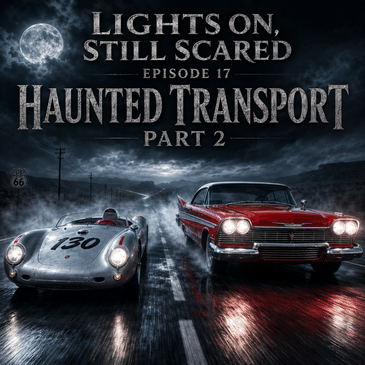
Haunted ships, eerie premonitions, and legendary transport disasters collide in this spooky conversation about why certain vehicles seem to carry a shadow with them. From the Titanic to a cursed-looking Porsche, the stories here explore the thin line between coincidence, intuition, and something far harder to explain.
Karen Swanston and Graham Milne dig into real-world maritime tragedy, reported hauntings, and infamous warnings that seemed to come true. Along the way, they ask the bigger question: are these just strange accidents and hindsight, or do some places and objects hold onto fear in ways we can still feel?
There’s also a chilling Scottish tale involving a stranded yacht and a spectral sailor, plus a powerful retelling of the Tay Bridge disaster and the eerie stories that grew around it. If you’re drawn to paranormal history, ghostly transport lore, and unexplained warnings, this one is packed with it.
Key Topics
[00:00:00] - Introduction to haunted transport stories and the Titanic
[00:01:09] - Titanic’s maiden voyage, collision, and sinking timeline
[00:02:35] - Ice warnings, wireless messages, and safety decisions
[00:04:26] - Ship design, flooding, and why the Titanic may have failed so quickly
[00:05:09] - Morgan Robertson’s Futility and eerie premonitions in fiction
[00:06:23] - Dreams, warnings, and passengers who sensed disaster before sailing
[00:07:35] - Titanic hauntings, museum reports, and paranormal claims tied to relics
[00:08:56] - The Silver Cloud incident off Fraserburgh and the young sailor apparition
[00:11:30] - The spirit’s warning and the connection to the Lancastria disaster
[00:13:51] - James Dean’s Porsche 550 Spyder and the “Little Bastard” legend
[00:16:20] - Alec Guinness’s warning and the fatal crash that followed
[00:19:19] - Rumors of curses around the wreck, parts, and later accidents
[00:22:11] - The Tay Bridge disaster and the man who avoided the doomed train
[00:26:59] - Later sightings of a phantom train near the Tay Bridge line
[00:28:53] - The story’s literary retelling and closing thoughts
Relevant Links List
Titanic history overview: https://www.britannica.com/topic/Titanic-ship
Titanic Belfast museum: https://titanicbelfast.com/
RMS Titanic Inc. / Titanic artifacts and recovery context: https://www.rmstitanicinc.com/
James Dean archive and biography: https://www.britannica.com/biography/James-Dean
Porsche 550 Spyder background: https://www.porsche.com/international/accessoriesandservice/classic/models/550-spyder/
Tay Bridge disaster overview: https://www.scottish-places.info/features/featurefirst2099.html
National Records of Scotland: https://www.nrscotland.gov.uk/
The Lancastria disaster history: https://www.iwm.org.uk/history/the-lancastria-disaster
Morgan Robertson’s Futility info: https://en.wikipedia.org/wiki/Futility,_or_the_Wreck_of_the_Titan
White Star Line history: https://www.white-star.co.uk/
The episode closes with a recurring theme throughout the discussion: some disasters seem to leave a story behind them that outlives the event itself. Whether you interpret these moments as warnings, psychic impressions, or coincidence, the emotional weight of each story is unmistakable.
And if transport can carry more than people and cargo, maybe it can also carry memory.
[00:00:00] - [Speaker 0]
Welcome back to lights on still scared my name is Karen Swanston and with my colleague Graham Milne we continue on haunted transports so all aboard lights on optional. If I was to say to you what is a famous boat that sunk, what would you say? Titanic. Titanic. So, yes, I thought Titanic needs a mention.
[00:01:09] - [Speaker 0]
Yes. Obviously, people know about the Titanic. So her maiden voyage was from Southampton to New York with calls at Cherbourg and Queenstown. Yes. Wherever that is.
[00:01:23] - [Speaker 0]
Do you know where that is?
[00:01:24] - [Speaker 1]
Cherbourg, France, Queenstown, South Africa? I don't know. Oh my word.
[00:01:30] - [Speaker 0]
That'd be a long way to go from to New York, wouldn't it? Oh dear. That was a scenic route
[00:01:36] - [Speaker 1]
they were taking, don't you know?
[00:01:37] - [Speaker 0]
Very scenic route.
[00:01:39] - [Speaker 1]
It was indeed. It wasn't much to see. It's all very blue.
[00:01:42] - [Speaker 0]
If that was the route they were taking, then then they obviously got lost. So she departed on the 04/10/1912, and the collision happened at 11:40PM, ship's time on the 04/14/1912. So a few days later, she hadn't been in the water that long. And approximately at 02:20AM is when she sunk on the April 15. So within a couple of hours, she was gone.
[00:02:09] - [Speaker 0]
Mhmm. The cause was an iceberg, and they were traveling at speed in the area where the ice
[00:02:14] - [Speaker 1]
Yeah.
[00:02:15] - [Speaker 0]
Had been reported. So it was approximately 2,200 passengers in queue, but exact totals vary slightly by the source. So I would have thought though that records would probably say how exactly number of people were on board. Yeah. Yeah.
[00:02:30] - [Speaker 0]
Yeah. But out of that, one thousand five hundred people passed away.
[00:02:35] - [Speaker 1]
Yeah.
[00:02:35] - [Speaker 0]
There was only seven hundred people that were rescued. They were rescued by the Carpathia. Mhmm. The documents say that the Titanic received or intercepted several wireless reports concerning ice from ships, including the California and the Baltic. Mhmm.
[00:02:52] - [Speaker 0]
So obviously, was several reports of ice, though, with a I don't know why they didn't take it. Well, perhaps I might say this in my in my notes. Mhmm. Captain Edward Smith and the bridge were aware of the ice lay along or near the route, but surviving evidence does not support the idea that the danger was completely unknown. So even though they were aware that there was icebergs in the area, I think they thought that they weren't in immediate danger.
[00:03:21] - [Speaker 0]
And also, they considered it not to be sinkable. They? Correct. It was unsinkable. So the Baltic sent a warning on April 14 reporting of the icebergs.
[00:03:31] - [Speaker 0]
Captain Smith showed the message to the White Star Line chairman, J. Bruce, is May, later retrieving it. So at 10:55PM, California's wireless operator advised that his ship stopped because it's surrounded by ice. The informal message interrupted Titanic's wireless operator Jack Phillips while he was working traffic with Cape Race and was not delivered as a formal bridge warning. I suppose he thought it wasn't serious enough to interrupt his work.
[00:04:05] - [Speaker 0]
Suppose he was getting all the messages from all the other people that were on board. So there's a lot of things that went on there. There's a case of they didn't get the warnings, they didn't think it was serious enough. And also I think that later on, quite recently, I think they've discovered perhaps there was a fire on board in the engine rooms. So it went off, started Yeah.
[00:04:26] - [Speaker 0]
On fire before
[00:04:27] - [Speaker 1]
There was also a lot of discussion about the the materials used and how substandard to get the thing completed. And I know that in the lower decks, they had these compartments and strangely enough, I don't think if I remember correctly, they didn't actually reach the floor so they went so far up from the floor upwards but didn't seal off so it wasn't individual sealed compartments. So when the first part was breached and it flooded and it began to flood, the water would then obviously get through into each one rather than be stopped and I think that's partially why it happened or, you know, go overwhelmed so quickly.
[00:05:07] - [Speaker 0]
I think that yeah.
[00:05:09] - [Speaker 1]
I think
[00:05:09] - [Speaker 0]
there's a number of things. But what is interesting that a person called Morgan Robertson published Futility in 1898, fourteen years before Titanic sank. And in that story, he features enormous liner called Titan, described an exceptionally safe which strikes an iceberg in the North Atlantic and carries very few lifeboats.
[00:05:34] - [Speaker 1]
Right.
[00:05:35] - [Speaker 0]
It's very similar to I mean, was it prediction that he'd done? Was it a case of He knew. Apparently, he was an engineer, so he denied that he was clairvoyant and he just said his maritime experience allowed him to interpret trends towards a larger, faster liners and recognize the problem. All very interesting. There's W.
[00:05:57] - [Speaker 0]
T. Stead, who's a journalist and spiritualist, who was traveling in the first class passenger and died on the sinking. But in 1886, he wrote a fictional book and counted out a Mau steamer sinking after a collision and many lives lost because there's too few lifeboats. I mean, they're predicting stuff, but as the other person said, it could be because they knew that Yeah. The boats were
[00:06:23] - [Speaker 1]
The protocols weren't right in sense.
[00:06:26] - [Speaker 0]
Yeah. And many passengers reported dreams of the sinking before they got on. A few passengers actually cancelled before they got on there.
[00:06:34] - [Speaker 1]
Right. Yeah.
[00:06:35] - [Speaker 0]
So there's one particular passenger called Esther Hart travelling second class with her husband Benjamin and daughter Eva, reportedly felt deeply uneased about the voyage and remained dressed at night rather than fully prepared for sleep. Her daughter Eva later recalled her mother's conviction that calling a ship unsinkable was flying in the face of God. Esther and Eva survived and Benjamin died. Then there was also a letter from a Henry Wilde, who's the chief officer, who often said to have written that he still disliked the Titanic and a strange feeling about the ship. So even before it was built, people were still having feelings about it.
[00:07:13] - [Speaker 1]
Yeah. Yeah. It's horrible. It's incredibly sad, you know. I was in the Titanic Museum in Belfast a few years ago and I don't know.
[00:07:25] - [Speaker 1]
I I don't think you can go there and not feel moved by what happened. It's it's such a terrible situation. Would've don't bear thinking about it really, poor souls, but Indeed.
[00:07:35] - [Speaker 0]
So no intact Titanic returned to become a perpetual ghost ship. So, I mean, it's not like she's the ghost ship that suddenly appears. Yeah. But around the the area where she is, apparently, they are all being seen.
[00:07:48] - [Speaker 1]
Yeah.
[00:07:49] - [Speaker 0]
And when there's an exhibition on, there's reports of footsteps, voices, cold spots, shadowy figures, and the feeling being watched. And these are reported by staff and visitors as well.
[00:08:01] - [Speaker 1]
Mhmm.
[00:08:01] - [Speaker 0]
And the Titanic Museum attraction in Branson, Missouri has been investigated because of the paranormal activity associated with relics. Mhmm. So claims involved a child, a crewman, or a woman in period dressed are often repeated. So yes. So there's lots of people actually say that they see things.
[00:08:19] - [Speaker 0]
And and what is interesting is there's gonna be an exhibition up on where is it? The Highlands Centre in Edinburgh in November.
[00:08:28] - [Speaker 1]
Right.
[00:08:29] - [Speaker 0]
And they've got apparently got loads of artifacts there from the Titanic, so that'd be interesting to see whether they have any spookiness. Yeah. No. 100%. Indeed.
[00:08:37] - [Speaker 1]
And there's a lot a lot of artefacts being I know there's still a lot still, you know, the site but there has been a lot retrieved and lots of different I
[00:08:48] - [Speaker 0]
mean they did say that they wouldn't bring her out because obviously out of respect for the people that died there.
[00:08:56] - [Speaker 1]
So I've got a little story for you guys. This is quite an interesting one and it's from the North Of Scotland and it's a creepy tale but I think it's quite creepy. And it took place just off Fraserburgh, which lies just South of Macduff. So Fraserburgh, in case you didn't know, is a fishing village and in 1974, the crew of a grounded yacht ended up staying there for several days. So basically what happened was the Silver Cloud which was a wee sailing ship, was en route from Inverness to France when it ran aground at Rattray Sands which is like a big sand bank outside the Fraserburgh.
[00:09:40] - [Speaker 1]
It ran aground in thick fog and people speculated that perhaps the boat was cursed as four months prior to running aground the owner of the vessel had fallen onto the deck while preparing for the voyage and ended up being quite badly injured and he was now confined to Ragmore Hospital in Inverness for eight weeks. However he insisted that the sailing trip he had planned go ahead without him. So the four man crew had already been picked but they were supplemented by two guests who I assume were maybe paying to be, you know, on this trip and it was a French woman called Marcel Mortlock and her husband. So on setting sail, the first lady journey was quite uneventful but at night the woman became convinced that somebody would be visiting her in the cabin, spectral figure of a young man. So this was happening quite often.
[00:10:36] - [Speaker 1]
He was a young sailor, on seven or eight occasions while sailing he appeared and on sighting, one sighting had actually even occurred while Mrs. Mortlock and the owner's wife were still docked in Inverness discussing you know, they're shopping what we're going to buy for the trip and this guy would appear but nobody else would see him it was just you know this French lady so I don't know how much she was actually divulging this at the moment but she was seeing him and yeah, it was quite creepy. He was young, fresh faced, he wore a cap with the name Lancaster or Lancastrian upon it. Okay, so as the journey commenced and throughout the voyage he then would randomly appear in the middle of the night or when she's lying in bed and one can only imagine it was quite frightening for her. No one else was, you know, aware of his presence.
[00:11:30] - [Speaker 1]
On what was to be the last sighting she had, she was lying in her bunk when the figure appeared in the room but on that occasion he actually physically spoke to her and he stated that the boat would be beset with difficulty but not to be afraid as everything would be alright. So she was quite frightened by this, didn't quite recall the exact words but said he was there for around fifteen minutes talking and then soon after boat runs aground. Now they're stuck in a sandbag for a number of days and it was a bad storm and basically for the safety of the guests they were taken on shore, certainly the two French people and they were put in a coast guard's house where they were looked after while the rest of the crew stayed another couple of days on stranded ship to see what was happening. And she found out later on that the cap on young man's head had actually described as I think Lancastria. So she kinda misread it but she was close enough and the Lancastria was a boat, well, a ship that sank off Saint Nazaire in June 1940 which is off Brittany and it was bombed by the Luftwaffe and the boat sank and they suggest between four or 5,000 people were actually lost.
[00:12:52] - [Speaker 0]
Really?
[00:12:52] - [Speaker 1]
Yeah. That's a lot. There's a lot. It was one of the biggest maritime disasters ever during the war. So they wonder if this young sailor spirit was there to kind of let them know that nothing bad was going to happen as a warning because that's the only connection that could possibly be.
[00:13:08] - [Speaker 1]
Yeah. And that's a true story from 1974. So we've seen eight times during the voyage and he actually physically spoke to her. So yeah. Scary stuff.
[00:13:18] - [Speaker 1]
It was in a few newspapers at the time, it's quite an obscure one but certainly from that neck of the woods it can almost be forgotten about.
[00:13:26] - [Speaker 0]
Even though she find it scary, he was trying to reassure her
[00:13:29] - [Speaker 1]
who she
[00:13:29] - [Speaker 0]
was spooky or whatever.
[00:13:31] - [Speaker 1]
Crisis apparition maybe? I don't know, crisis apparition perhaps, I don't know. I mean thankfully nobody was injured anyway and as far as I know there's been no sort of mention of what happened in the journey when the boat set sail again, if it ever did. I know if it did set sail, it was kind of abandoned, the project, I'm not sure. Yeah, that was 1974.
[00:13:51] - [Speaker 0]
Very good. What have you got? I have got another car.
[00:13:55] - [Speaker 1]
A
[00:13:55] - [Speaker 0]
car? I've got the cars here. Yes. Yeah. That's good.
[00:13:58] - [Speaker 0]
Cars are good. Yeah. So it's a 1955 Porsche five fifty Spider, which is a very well known car because it belonged to James Dean.
[00:14:10] - [Speaker 1]
Okay.
[00:14:11] - [Speaker 0]
So it was purchased in 09/21/1955. I think it was actually made for him rather than that. He actually took it off the got it off the Valkolt. James Steve was not simply just an acty. He was an enthusiastic and increasingly experienced amateur racing driver.
[00:14:28] - [Speaker 0]
Uh-huh. So he previously raced a Porsche, a 356 Bista, and achieved respectable results at the California events. So he was quite experienced then when he was driving. And he's obviously used to driving those kinds of cars. And Warner Brothers temporarily prevented him from racing while he was making the field giant because an injury could have jeopardized the production.
[00:14:53] - [Speaker 1]
But
[00:14:54] - [Speaker 0]
once filming's completed, he exchanged his speedster for a faster, lighter, more demanding Porsche five fifty Spider. Mhmm. The car was purpose built competition car with extremely low, lightweight, and difficult for drivers of ordinary cars to see. So Mhmm. This could be part of the reason why.
[00:15:15] - [Speaker 0]
Yeah. Dean entered the car for the Asalliance Road races scheduled for the first and second of October nineteen fifty five. So the word little bastard was painted on the the rear of the porch Nice. By pinstriper Dean Jeffries. His workshop was close to George Barris' premises, and I think George was the actual person who designed the car.
[00:15:40] - [Speaker 1]
Right.
[00:15:41] - [Speaker 0]
And the reason why he it was called Little Bastard was because apparently that was his nickname, James Dean's nickname.
[00:15:48] - [Speaker 1]
It was Bastard?
[00:15:49] - [Speaker 0]
It was yeah. He was known as Little Bastard. One explanation is stunt driver Bill Hickman called Dean Little Bastard.
[00:15:56] - [Speaker 1]
Right.
[00:15:57] - [Speaker 0]
And Dean called Hickman big bastard. Hence, weird little verdict there. Yeah. And apparently, British actor Alex Guinness, as in
[00:16:08] - [Speaker 1]
Yes.
[00:16:08] - [Speaker 0]
These are not the drugs you're looking for.
[00:16:10] - [Speaker 1]
Yes.
[00:16:11] - [Speaker 0]
Described a meeting with James Dean in Los Angeles on Friday, 09/23/1955, which was one week before Dean died.
[00:16:20] - [Speaker 1]
Mhmm.
[00:16:20] - [Speaker 0]
Dean showed Guinness the newly delivered silver Porsche outside restaurant. Mhmm. In his 1985 autobiography called Blessings in Disguise, apparently, Guinness wrote that the car appeared sinister to him.
[00:16:34] - [Speaker 1]
Really?
[00:16:34] - [Speaker 0]
Guinness said that he urged Dean never to enter the car and warned that if he did, he would be found dead in it by the same time the following week. So Dean apparently laughed off the warning and then James Dean was fatally killed in the Porsche the following Friday, which was the September 30. Right. So
[00:16:54] - [Speaker 1]
So was Art Gin a psychic then?
[00:16:55] - [Speaker 0]
Oh, don't know. Don't know. But he obviously felt that there was something. Probably not quite right with the car. Yeah.
[00:17:02] - [Speaker 0]
So apparently, the final journey, Dean and the Porsche mechanic prepared the Spider for the race meeting. The original plan was to tow the Porsche behind a Ford station wagon driven by the stunt driver, Bill Hickman, who we've mentioned before. Right. The mechanic reportedly recommended driving the Porsche to Salinas so Dean could get some experience and put additional miles on the new car. Yeah.
[00:17:26] - [Speaker 0]
So I suppose he wanted him to get the feel of the car before the actual
[00:17:28] - [Speaker 1]
Makes sense.
[00:17:29] - [Speaker 0]
Race. And Dean had stopped earlier in the journey and was issued a speeding ticket. So he was he was Yeah.
[00:17:37] - [Speaker 1]
It's a good start.
[00:17:38] - [Speaker 0]
Yeah. It's a good start. At approximately 05:45PM, Dean approached the junction of Route 466 And 41 and near Cheylem, California. Mhmm. A Ford driven by a 23 year old Donald Turnupsteed began turning left across the porch's path.
[00:17:56] - [Speaker 0]
He said he did not see the car because it was so low until it was too late. The vehicle was collided. The Porsche was thrown off the road and badly crushed. The mechanic was thrown for the car and survived with severe injuries. Dean remained trapped and suffered catastrophic injuries and was pronounced dead before he arrived at the hospital.
[00:18:16] - [Speaker 0]
And he was only 24, so I didn't realize he was that young. But yeah.
[00:18:19] - [Speaker 1]
Of course, he made three films to leave.
[00:18:21] - [Speaker 0]
Yep. Indeed. So yeah. So the inquest was held 10/10/1955, returned to verdict of accidental death with no criminal intent.
[00:18:29] - [Speaker 1]
Mhmm.
[00:18:30] - [Speaker 0]
The other driver was not charged with the offence. Mhmm. I suppose if he couldn't see him, he had no
[00:18:35] - [Speaker 1]
Yeah. Yeah.
[00:18:36] - [Speaker 0]
And perhaps perhaps speed might have been part flirt as well.
[00:18:40] - [Speaker 1]
Potentially.
[00:18:42] - [Speaker 0]
Oh, dear. So shortly before his death, which is quite ironic, Dean appeared with an actor Giga Young in a road safety television And Dean warned viewers that driving fast on public roads could be more dangerous than racing on a track. So instead of delivering the plan closing line, the life you save may be your own, Dean changed it to the life you save might be mine.
[00:19:10] - [Speaker 1]
Right.
[00:19:11] - [Speaker 0]
Yeah. So that's quite an eerie prediction, suppose, considering the way he went. So, yeah, so what happened to the tracks was the insurance declared the Porsche a total loss and made settlement to Dean's father. And the sandwich passed to doctor William F Esprich, a physician and racing driver. So it was stripped, and badly damaged body was subsequently obtained by George Barris.
[00:19:41] - [Speaker 1]
Mhmm.
[00:19:41] - [Speaker 0]
And Barris displayed the wreck as Jane Dean's last sports car and road safety exhibitions. So yeah. So the alleged curse of this, it claims that the wreck fell from the display or trailer and injured a mechanic. Mhmm. Other versions said that the car slipped from the supports and broke someone's leg.
[00:19:59] - [Speaker 1]
Right.
[00:20:00] - [Speaker 0]
The truck transporting the wreck was allegedly involved in a fatal accident. Although reliability to this it's difficult to find.
[00:20:09] - [Speaker 1]
Yeah. Of course. Of course.
[00:20:10] - [Speaker 0]
The tires supposedly taken from Dean's Porsche were said to have blown simultaneously and caused another crash. I think all tires blowing at the same time is Mhmm. Almost unheard of. Mhmm. And the garage door in the wreck caught fire in March 1959.
[00:20:26] - [Speaker 0]
So it's all adding up that it is perhaps not as spooky as the other car that I mentioned.
[00:20:32] - [Speaker 1]
But Mhmm.
[00:20:32] - [Speaker 0]
Yeah, it's it's it's a car that doesn't like like being driven. But what's interesting is that this was made a one off. So why why why was it like that? If there's any such things as haunted or cursed things. What what cursed it?
[00:20:51] - [Speaker 0]
What made it haunted? I shall leave that one there.
[00:20:54] - [Speaker 1]
When when things like that happen to them, people have these experiences, you know, and and it's so easy to say, you know. You can relate it back to something and it's it becomes mythical. You know, I mean, a garage could burn down, car could crash.
[00:21:10] - [Speaker 0]
Yeah. I suppose it's all down to coincidence. Yeah. All down to coincidence. Do you believe in coincidences?
[00:21:17] - [Speaker 1]
Depends how coincidental they are. There are occasions where people said it's a coincidence when I actually believe, you know, in supernatural in a supernatural sense that it is something more because it's too it's too it's stretching credibility Mhmm. To just be, you know, close to coincidence all day long, but I've been in a few instances where, you know, you're well, I'm convinced that ghosts or whatever have appeared to give a sign, I'm sure. But it depends on your point of view. If you're a skeptic you'll always go for it's coincidence, you know, you're always going to look for the kind of most rational answer.
[00:21:59] - [Speaker 0]
Indeed. Indeed.
[00:22:01] - [Speaker 1]
I'm I'm maybe I'm irrational. I don't really know. But I do like to have a wee look and think, maybe. Maybe there's something else about who knows? I've got a story.
[00:22:11] - [Speaker 1]
Now this is a wee bit of a longing, so Oh,
[00:22:13] - [Speaker 0]
okay. I'll
[00:22:13] - [Speaker 1]
send it. This is quite an interesting one because it's connected to the Tay Bridge disaster.
[00:22:23] - [Speaker 0]
Oh, yes. That's an old one.
[00:22:25] - [Speaker 1]
Yeah. Which in 12/28/1879, the train heading from Lookers to Dundee went off the bridge and it collapsed. The bridge collapsed. It had been only opened a matter of months during the storm of course resulting in the death of seventy five people and again they suggest later on that the bridge, the quality of the material was compromised to save money so it was probably one of the worst real disasters ever in Britain, and there must have been a few by the way, but this was one of the worst. And the story that I'm gonna tell you now was presented in a book Ghosts of Saint Andrews by a guy called, William Thomas Linskull who stayed in Saint Andrews.
[00:23:14] - [Speaker 1]
He was what's called Dean of Guild. So he kinda looked after buildings, and he was an antiquarian and he had a lot to do with the golf course and he wrote this very famous ghost book, I think it was about 1911 it came out and it kind of stuck, so the stories have been around ever since but he actually is one of the only people who missed the train which meant he could have very well ended up seventy sixth dead person. It's quite an interesting story. In a nutshell what happened was a couple of weeks before the actual train crash, he was waiting for a train north from Grantham and as he waited on the platform, was approached by an excitable man who he described as being middle aged and well dressed. He appeared very agitated and intimated that he must speak to Mr.
[00:24:05] - [Speaker 1]
Linskull as a matter of urgency. Now Linskull had never met a guy in his life, so why does this guy need to speak to him? You know, he was kind of taken aback by this, but he listened as the man sort of literally grabbed his arm and explained that for three consecutive nights he'd had a dream and in that dream a terrible tragedy would occur and that the coming express in its journey north was to meet a dire catastrophe and he basically begged Linskol not to get on to the train. So the narrator, as in Linskol, questioned both the man's motive and possible sanity and then entered the carriage despite the other begging him and as the train left the platform he noted that the man looked very distraught and had his head down and so the journey was one that was not very pleasurable because he was concerned that something may happen. But anyway, on reaching St Andrews it was uneventful and he thought well, this may be some weird coincidence or maybe the guy was delusional or whatever and he kind of forgot about it.
[00:25:07] - [Speaker 1]
Some weeks later, he's about to board a train at Luchers and this train is now going to Dundee. He'd intended to take a cab at the time but the cab had been late so he jumped on the train at the last minute. As the train was beginning to head out the platform the stationmaster shouted across to him Here's your cab sir! So he decided in a split second I'll take the cab and he jumped off the train
[00:25:33] - [Speaker 0]
with
[00:25:33] - [Speaker 1]
a really gathered speed but he forgot his luggage and the luggage and the train headed off. Now as the train approached Dundee the storm got more and more ferocious and at the time when it approached there there was a chap at the end who waved onto the bridge and watched as the tail light headed off and then halfway through when it got to an area called the High Girders, there was a kind of little spark went there and then complete blackness and that's when they knew something was up. So these two guys then literally had to crawl through the tracks almost horizontally to avoid this savage wind which was, you know, a brutal storm and then they realized that half the bridge was missing, the train was gone and they could do nothing about it. So 75 people were lost and eventually of course they did dredge the train up which they reused bizarrely enough. I know.
[00:26:26] - [Speaker 1]
It was kind of known as a kind of death train if you like but he was convinced that he had avoided that fate except the guy who told him to avoid it had been two weeks early. So soon after they fished out his luggage which was at the bottom of the tee, all salty and briny and Julie delivered back to mister Linsco. It happened that a few other people involved in this. There was a a few other people across Scotland who had premonitions around the same time. So it's seen he was known as the man, I the man who avoided the Tay Bridge disaster.
[00:26:59] - [Speaker 1]
I don't how he felt about that, can you get survivor's guilt or whatever. But intriguingly, in more modern times there were two witness accounts of two teenagers who were out walking through the Fife countryside heading towards an underpass which led from Dundee to Edinburgh, so Dundee to Edinburgh line. While they were walking there they witnessed what was described as a phantom train. It was a dark winter's night and when the pair decided to head back along this country lane they had walked the road on many occasions, would frequently see and hear trains but that night things were very different because it was a much more slow moving train and as they got there, they looked up, the noise was thunderous as in a steam train and when they looked up they saw it pass ahead and in each window was a sultry lamp and they could see the white wine drawn faces of each person sitting at the looking at them which is quite frightening. Yeah.
[00:27:53] - [Speaker 1]
And then it headed off. They felt they'd stepped in some weird kind of, I know, a time slip or whatever but it was a scary one. Yeah. And off the train went, never be seen again. Of course when they got home they explained this to their families and you know, have you been drinking or whatever, quainted my mind.
[00:28:10] - [Speaker 1]
But yeah, it was a very scary story and allegedly they saw it, well what they think was the ghost train, if you Yeah. But Linscott was very lucky and had he gone on that train, well, we wouldn't have had that ghost book about St Andrews, that's for sure.
[00:28:24] - [Speaker 0]
No, no. But that's quite I mean, with disasters like that, that's quite common, isn't it, where people say, well Yeah. Yeah. It's like 09:11 with number of people that missed their buses or missed their trains. Yeah.
[00:28:39] - [Speaker 0]
And they were meant to be at the towers or nearby. Yeah. Yeah. So that's quite yes. So is it a case of your time's not up?
[00:28:50] - [Speaker 0]
Yeah. That's one thing. Have we all got sell by date?
[00:28:53] - [Speaker 1]
Maybe. There's a really interesting story called the man who missed I think it's called the man who missed the Taybridge disaster and believe it or not it's an American author who went under the pseudonym Saoirse de Liodes and I hope I've pronounced that correctly.
[00:29:10] - [Speaker 0]
Sorry, I've had trouble pronouncing I names all
[00:29:13] - [Speaker 1]
always thought she was, a Gaelic speaker and a man. Would, because I didn't speak Gaelic so I found it difficult to understand the name and I realised it wasn't, it was actually an American lady who wrote under a pseudonym Scottish mythology. She collected stories and wrote stories and that's a really good story. It's quite nice. And I'm assuming it must be Lynsko she had in mind when she wrote that story.
[00:29:43] - [Speaker 1]
Yeah. That's it. That's Tainbridge Disaster.
[00:29:45] - [Speaker 0]
That's a good one. Mhmm. Yes. Hope you enjoyed that episode. Join us next week for more spooky stories.
[00:29:52] - [Speaker 0]
In the meantime, keep the lights on, still scared.